The Siren Song: John Sebastiano Vineyard
“Slow down, please,” he said.
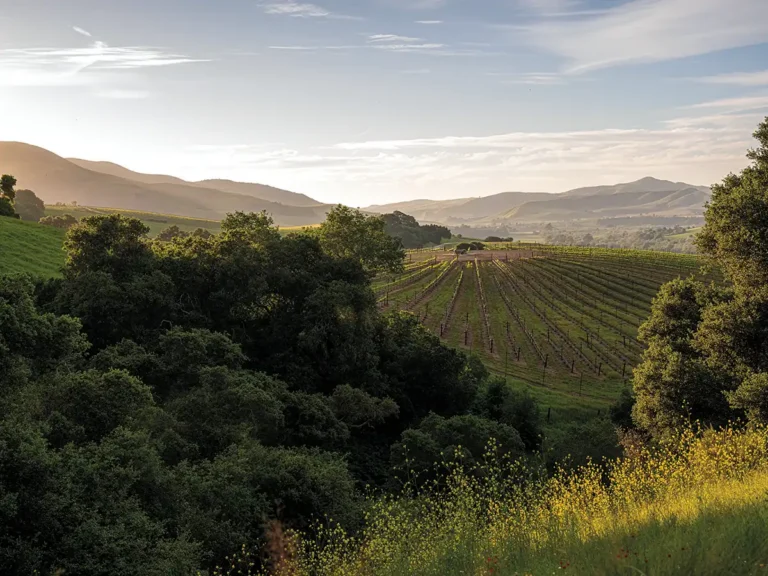
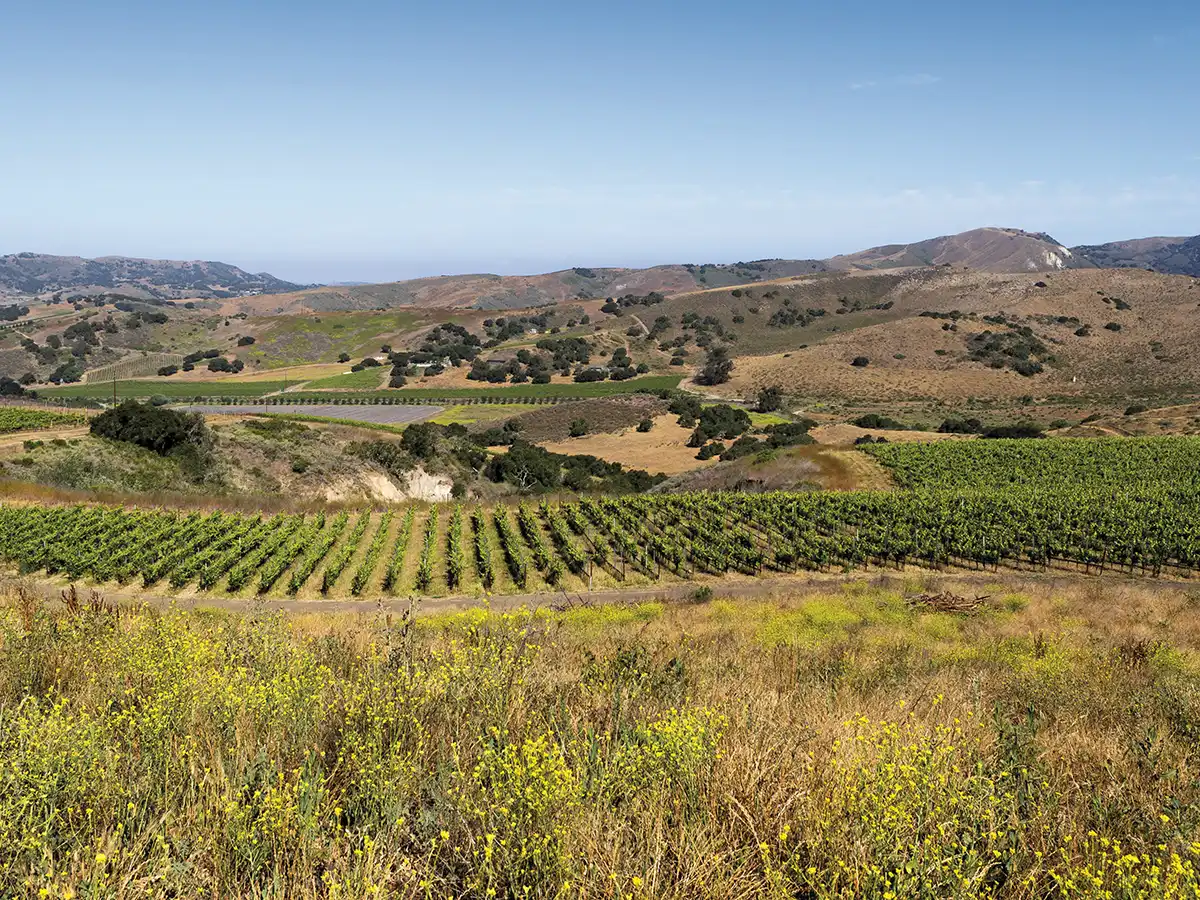
“Ten miles an hour is the slowest I can go,” I laughed. We were driving downhill at John Sebastiano Vineyard and my friend was obviously nervous. He was having déjà vu with those dreams we’ve all had where we’re peering over a cliff’s edge to our fate. The drive uphill is a bit deceptive. The slope gradually increases, one beautifully rolling hill after another. The chiseled rawness of the landscape renders the elevation imperceptible. It takes a responsible driver about 15 minutes to drive from State Route 246 at sea level to the tippy top. I did rush a bit, as I was excited to show him the ridgetop section of Picpoul Blanc vines. My dream is to source fruit exclusively from the Sta. Rita Hills, the place where everything began to make sense for me in the wine industry, and this Picpoul block was one step closer to achieving that goal.
To be certain, I am an anomaly in this pursuit. Rhône varieties are still somewhat rare in these cool-climate parts. Many would say for good reason. To them, it simply doesn’t get warm enough for long enough to achieve the luxurious flavor they seek in Rhône-style wines. That is precisely where I find the magic: exploring the delta between the nuanced gradations of ripeness. Which is a Sisyphean task without a true answer, though it aligns with my natural default to be contrarian.
Blame it on my upbringing. A first-generation Macedonian born to immigrant parents in Detroit from a boisterous party-loving family. My goal in seeking alternative paths is not to prove a point. I am often wrong. The curiosity in me is simply insatiable. My modern-day story began when my family decided to train north across the Balkans toward Genoa, Italy, in 1968 and board the SS Michelangelo for an Atlantic journey to New York, then take another train to Oakwood, Michigan, just outside of Detroit. They lived in a house with five families next to a factory; a few folks had to sleep in the enclosed porch. Every morning, they woke up covered in black ash. And one by one they figured it out. The journey in life for some of us is to learn what else is out there by crossing unknown boundaries.
John Sebastiano Vineyard (colloquially referred to in the industry as JSV) awakened my senses to a new kind of opportunity. Sounds silly even as I write this, though it’s true. When I started making wine in 2004, John Sebastiano didn’t exist, and the Sta. Rita Hills was still a nascent AVA, beginning to establish its foothold as a Pinot Noir and Chardonnay destination within Santa Barbara wine country. Sure, there was a little bit of Syrah. Santa Barbara Winery grafted Syrah in 1991 on self-rooted Chenin Blanc (that is another story) and Melville planted Syrah in 1998. The local gossip was that this was folly; it wasn’t warm enough to ripen hardy Syrah vines in these cold parts.
My search for Rhône varieties in those early years took me all over the warmer regions of the Santa Ynez Valley. Not having my own vineyards, I rely on the kindness of others to partner in their investment. The benchmark established vineyards had made a name for themselves with their gorgeous wines in these friendlier areas. Think Zaca Mesa, QUPÉ, Fess Parker, Stolpman, and Andrew Murray to name a few. Plus, a quick review of Santa Barbara AVAs is a study in course corrections over the years. Cabernet Sauvignon was once planted in the Sta. Rita Hills, along with Zinfandel and Gewürztraminer. The Sta. Rita Hills was soon to specialize in fragile grapes like Pinot Noir and Chardonnay seeking tender loving care, not robust heat-loving varieties. Therefore, following Old World wine sensibilities, traditional hardier varieties like Cabernet Sauvignon and Merlot migrated east toward warmer Happy Canyon and Pinot Noir came to mark the west.
The thought of thick-skinned Rhône-variety grapes in the cool climes was therefore a violation of the defining identities everyone had worked so hard for over the years. It wasn’t until JSV custom planted Grenache that became available to me in 2014 that my world turned. It’s like the genie popped out of the bottle fulfilling a wish I didn’t even know I had. I tasted something that I still can’t understand. It was wild, fresh and full of freedom. From that point forward I sought to source everything I could from the Sta. Rita Hills. This isn’t everyone’s bag and people often ask me why. I even tried explaining it to my mom—we share two languages. I couldn’t find the words, except to say that wine is slow. We learn in one-year increments and each year is 100% unique to itself, which further complicates the examination and enhances the mystery.
There is an extreme sports sort of feel to John Sebastiano Vineyard. In its heyday, 150 acres of this 1,000-acre property were planted to a patchwork of over 40 different blocks covering unique aspects, slopes, degrees, vine row orientation, varieties and clones up and down this hillside, along canyons and in the valleys. Imagine riding an old wooden roller coaster like the Blue Streak at Cedar Point—you Midwestern kids would understand—simultaneously thrilling and terrifying particularly when you approach the upside-down curlicue because of the precarious nature of the material, location and exposure. You try to keep your hands up the entire ride, though you just can’t defy gravity. To make matters more challenging, 30 different wineries were sourcing fruit from this gem at the eastern edge of the Sta. Rita Hills seeking 30 different ways of farming to their specifications.
John Sebastiano Vineyard started as a partnership between two people—John Wagner and Sebastiano Sterpa. Wagner achieved major success by happy accident with a different vineyard he had acquired a few years back in the early 2000s called Sierra Madre in Santa Maria. Recently replanted by Robert Mondavi, the project was overly ambitious in its financial ability to recoup its investment, not unlike what many vineyard owners are facing in the current state of the industry—oversupply versus under-demand in a very capital-intensive field. The property was going bankrupt and Mondavi split the parcel in two for an easier sale. John Wagner purchased one-half that was planted to 100 acres of Pinot Noir and about 100 acres of Chardonnay.
Wagner grew up on a small family farm in Camarillo where his dad, a chemistry teacher at Moorpark College, had 20 acres of avocados and lemons. He enjoyed the agricultural lifestyle, climbing trees and picking fruit with the crews during the summer, though he moved in a different direction as an adult. At UCLA he studied physics, then continued for his PhD. He even worked a short stint at the Los Alamos National Laboratory in nuclear physics. He left science after realizing the closer he got to the top he was no longer the smartest guy in the room.
“People who win Nobel Prizes in physics are really special,” Wagner said. “I had several of them as professors and friends. I just looked around and realized I wasn’t as talented as they were.” At that time in the 1980s he said a reasonable amount of people with math and science backgrounds were migrating to the financial world to build predictive models. He got a job learning the bond market at Drexel Burnham Lambert, and in 1991 he was asked to create his own fund.
The decision to add vineyards to his portfolio came about during the first tech crash in 2000. “I had seen all of these people worth a billion dollars suddenly worth nothing,” he said. “I was lamenting that everything I owned existed as electrons in an air-conditioned room spinning around on a piece of aluminum. I wanted something tangible.”
A broker colleague, Jeff Beckmen, son of Tom Beckmen of Beckmen Vineyards & Winery, told him about inexpensive vineyard land in Santa Barbara. Tom Beckmen had sold Roland Corp. U.S., a huge player in the electronic music industry, a few years before and established his winery. Wagner went to visit, and Tom handed him a brochure for Sierra Madre. Mondavi was selling it for less than its value as strawberry farmland. Wagner thought, well, at least he could lease it to a strawberry farmer. He bid and they sold.
“Mercifully, a year or so after I acquired the property, the movie Sideways came out and Pinot Noir prices skyrocketed from $2,000 a ton to $4,000 a ton,” Wagner said. He looked like a genius. The next few years were very rewarding, particularly in the Santa Ynez Valley, as the film created an unparalleled thirst for all things Pinot Noir. People who never drank wine or had never heard of Pinot Noir were suddenly obsessed. Wagner did well on his investment.
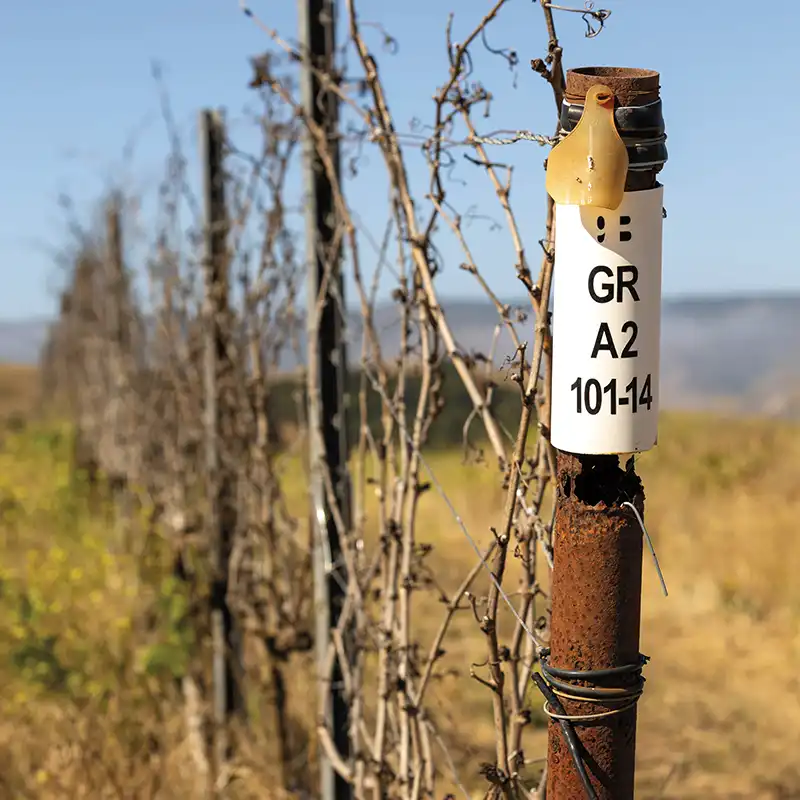
John Sebastiano Vineyard came into focus when Sebastiano Sterpa, a successful real estate broker and dear friend to Wagner’s wife’s family, proposed a partnership with him. Sterpa had purchased the 1,000-acre property just west of Buellton decades earlier. Seeing the success Wagner had with Sierra Madre, Sterpa approached Wagner to plant the property to vines, and transition from grazing cattle to vineyards. They agreed to a 50/50 partnership with Sterpa owning the land and Wagner investing in planting. At that time, the price of planting was $50,000 an acre, though costlier on scale and ambition. They had to establish all the infrastructure—grading, roads, outbuildings, fencing, irrigation—everything necessary to turn raw land into world-class vineyards on a very inhospitable parcel. In 2008 they set stakes in the ground and planted 150 acres under the guidance of Coastal Vineyard Care & Associates (CVCA).
Word on the street was hot. The anticipation and buzz captivating. Because of CVCA’s Rolodex of clients, the fruit was 100% under contract to wine producers up and down the state before a grape was ever picked. Of course, 85% of the property was planted to Pinot Noir, still the darling of the era. Everyone wanted in.
The problems started almost immediately. The stock market crash of 2008–10 instigated by the mortgage crisis didn’t help matters in terms of producers’ ability to keep up with their payments, though on the agricultural side, several parcels failed and had to be replanted, sometimes repeatedly. The harsh environment was more difficult than anticipated. Farming costs were skyrocketing. JSV couldn’t tally the price of the fruit to what producers were willing to pay. Sideways Part II was nowhere in sight. Jump now 16 years later and the vineyard has essentially been losing money year after year while simultaneously producing some of the most coveted fruit from our area.
The first time I visited JSV was to source Grenache in 2014. I worked with the fruit for three years. It was both a miracle and a mirage. Miracle: The views. The scale. The splendor. I was in awe. Mirage: Seemingly impossible to farm meticulously and efficiently as each block is essentially its own microcosm in a larger swirling ecosystem of labor, managers, environment and costs. The Grenache vines have since been ripped out, along with a total of 100 acres and counting. JSV is down to less than 50 acres of its original glory. I was completely unaware of this until I went back in early 2024. I was thrilled that Mike Anderson, who now runs all of Wagner’s farming operations, had grafted Picpoul Blanc and Grenache Blanc onto low-performing Pinot Noir vines in a research effort to salvage the block. I could finally return to the origins of my awakening.
Wanting to better understand the vineyard landscape and where his money was going, Wagner started taking viticulture classes at UC Davis. “The answer is that none of us knew what we were doing,” Wagner said. “To be honest, we were completely clueless. I would be considerably wealthier if I had never bothered to learn about JSV.” His instructor at Davis was Mike Anderson, who for years managed the university’s Oakville Research Station in Napa. Oakville is known in wine circles for its vital trials on clones, vine spacing, rootstock, irrigation and more. Wagner enticed Anderson to join him in the Sta. Rita Hills upon his retirement to lead the team.
On that first visit back to JSV, I had marked 20 years in the wine industry, and I was awestruck even more at just how bold this project was. I began to get teary. Ridiculous, I know. In the truck with Anderson and coordinator Cassidy Cushman, as we slowly ascended the hill, I was dumbfounded. Block after block evidenced piles of gnarled pulled-out vines. My stomach was in knots. Pinot Noir. Syrah. Chardonnay. What happened? The summary answer was this: Buyers no longer wanted, or were able, to pay for the true cost of farming this vineyard. Grapes were going unsold. Producers dropped their contracts. Anderson basically said they could no longer go about subsidizing the wine industry. No buyer: no vines.
I know that I am part of the problem. The fluctuations in the wine industry make it tremendously challenging to keep a business afloat if it is your only source of income that you rely on to pay your mortgage, payroll, rent, health insurance, car payment, etc. The benefit of not owning your own vineyards is that you can be flexible. Increase and decrease production based on market demand. To be clear, this is not easy, either. Wine is slow, remember? The ability to correct the imbalance can take years. The detriment of not owning your own vineyards is that you are at the mercy of the vineyard owners and their situation, as well. When you are ready for their fruit again, it may not be available.
I am in no way saying it is easier to own vineyards, either. After doing the math over and over again it makes my stomach turn. Everyone has to win-win for the system to work. For years the mantra of some vineyard owners in response to pushback from wine producers on rising fruit costs was to simply charge more for the wine. Easier said than done when you are on the front lines selling wine. And on the front lines of selling grapes.
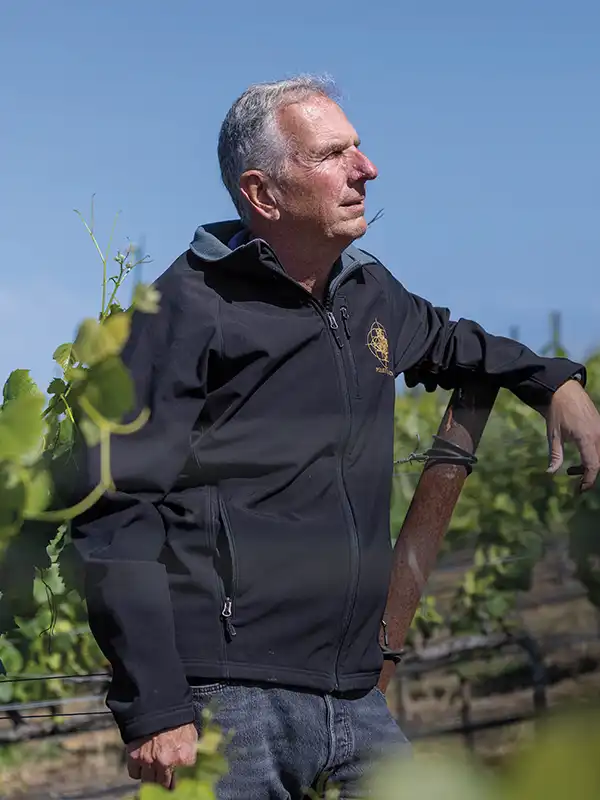
We can’t be sad for Wagner. The bruising he’s taken from JSV didn’t dissuade him from further investing in other vineyard projects. He has over the years bought and sold numerous vineyard properties up and down the state and did quite well in his dealings. Though JSV is the one that stings the most. His most recent passion project is his Peake Ranch estate vineyard and winery, which opened to the public in 2019, on the former Alma Rosa property once owned by Richard and Thekla Sanford, and the site of the original Sanford Winery tasting room next to the old strawbale house where the Sta. Rita Hills AVA petition was first chartered. Wagner saw the property in 2013 and was struck by its beauty. Boom, it hits once again.
I am sitting with Wagner now in the glass-enclosed tasting library overlooking the barrel room and production facilities at Peake Ranch. We are sipping Sierra Madre Chardonnay, listening as the beeping forklift below stacks barrels. I am trying to tug Wagner’s emotional heartstrings to reveal the nostalgia in his investments. Obviously, I am projecting. To me, being in the vineyard is the ultimate place of peace. Walking rows, studying structure, form, capabilities and possibilities caught up in the past, present and future all at once. He’s not biting. Probably because while he’s won a lot, he’s also lost some. And business is business. Sierra Madre is now down to only three acres of Chardonnay. The rest is leased as strawberry farms. The coveted Pinot Noir also ripped out. My eyes widen at the news.
“Sonja, you know how tough it is in this business in general,” Wagner said. “The Chardonnay we make from Sierra Madre gets 98 points. It is well reviewed; it is a classic absolutely wonderful wine and no one will pay us more than $1,800 a ton for the grapes. It costs us $10,000 an acre to grow it. We aren’t going to get six tons an acre from it. If you grow it here at Peake in the Sta. Rita Hills, you get $3,000 a ton. At that price you aren’t getting rich, though you are covering it.”

“So how do you move forward?” I ask. Just then Anderson walks into the room. I tell him I am trying to get John to be sensitive and open up, though my strategy of leading the witness is not working. Anderson is also not the emotional type. He grabs a glass and sits down. With his background, he is focused on science and data all the time. Though he does have a large, handsomely detailed Zinfandel cluster tattooed on his calf. That must have hurt.
“The California wine industry owes everything to Zinfandel,” he once told me. With Anderson’s assistance, the team at Peake has been tracking all the applicable data points in wine from grape to glass to determine which blocks are best for their program.
“The Sta. Rita Hills is a special place,” Anderson said. “Even JSV is a special place amidst the rest. The Pinot Noir from JSV for our blend is some of the best we’ve seen, and proportionally it is a primary integral part of that blend.”
“I guess this is the emotional part,” Wagner chimes in. “I would like Peake to be known as a place that grows some of the best grapes anywhere,” he said. “I would like to charge enough so that it makes a modest profit, like a dollar. On the winemaking side I would like to make great wine and have this place make a return. I have to believe there are enough people in the business to support, and that this is possible. I take some solace that if we grow really great fruit, people will make great wine, and the world is a better place for that.”
“And I guess soon,” he continued, glancing over at Anderson, “he and I are going to pick out seven or eight acres at JSV to plant Pinot Noir because I think there is a romantic notion that I would really like to be a part of creating truly great wine.”
“While you are at it, may I put in a request?” I asked.
Sonja Magdevski
Owner/winemaker of Clementine Carter Wines in Los Alamos, I approach my work with a lifetime of exquisite flavors, travel and experiences. A journalist by training and winemaker by drive, the two professions challenge me to craft timeless stories, each vintage and story at a time.