The Comfort of Congee
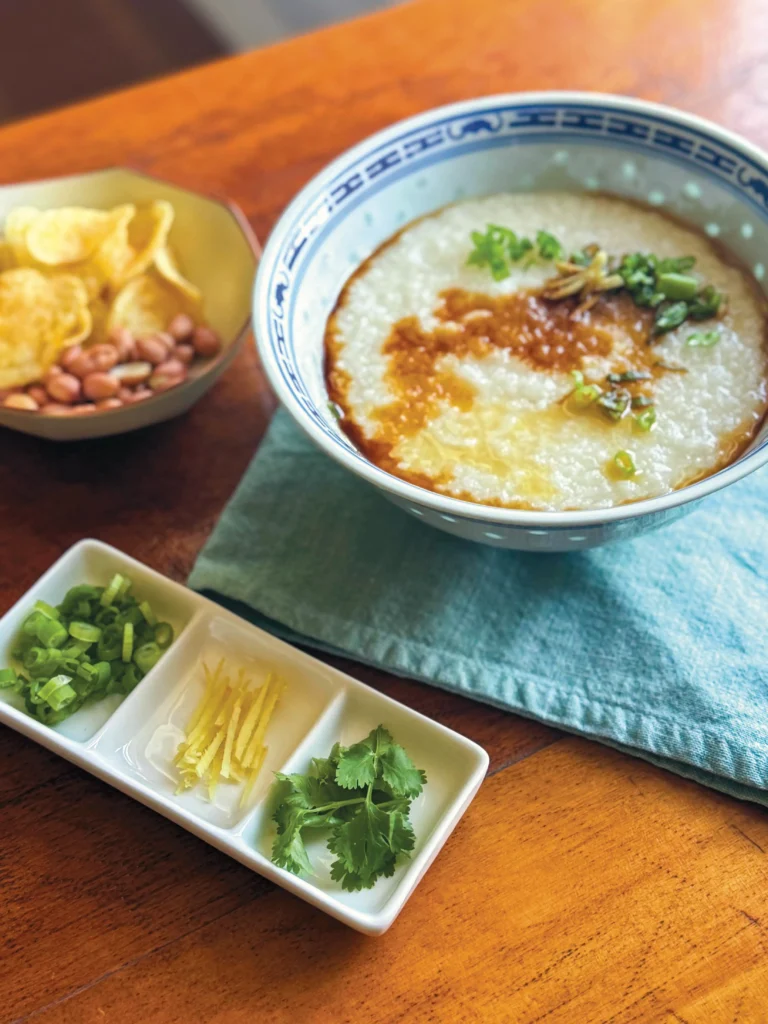
Silky and smooth, congee is comfort food. In Asian countries—at airports and hotels—you will observe weary travelers lining up for bowls of hot congee. Congee, also called jook in Cantonese, is rice porridge—rice simmered with a generous amount of liquid until it becomes thick and creamy. From there, add seasonings and toppings of your choice and make it as mild or as bold as you like.
Congee offers to heal what ails you. It’s readily digestible for a gentle boost of energy; it hydrates your system and lubricates your guts; its warm vapor of aromatics clears your nose and throat.
Congee is frugal fare. I was a child in 1941, when Britain surrendered Hong Kong to Japan. During the three years and eight months of military occupation, rice was rationed to about one cup per adult per day. Invariably, a large amount of sand was mixed into the rice and had to be picked out. Sitting on a high threshold inside a doorway, I carefully cradled a large flat tray. Grain by grain, I pushed the sand to one side, rice to the other, bran and husk to the edge. And don’t tip the tray as you stand up. I had a small pile of usable grain; that one cup of rice was gold. If my mother cooked that cup the regular way—with one cup of water—she had about two cups of fluffy rice. But if she cooked it with nine cups of water, she produced ten cups of congee. The same amount of starch appeared more abundant and could stretch to feed more hungry mouths.
Every rice-eating culture has some form of porridge based on that primary grain, variously named and embellished with beliefs. Originally Tamil, the word congee has become English, yet it remains relatively unknown in the West. It may never reach the popularity of porridge made from grits or oats here, so I am here to ease you into the idea of congee, and how approachable and forgiving it is to prepare. Considered mainly a breakfast food, its flexibility means it’ll soothe you and fill you up morning, noon and night.
Select Your Rice
You can make congee with any rice: white or brown; short-, medium- or long-grain; even leftover toasted or scorched rice. Each gives a slightly different taste and texture. For a bowl with maximum comfort, choose a rice high in amylopectin (think sushi rice) and lower in amylose (like basmati), which yields a creamier result.
We in Santa Barbara benefit from excellent California medium-grain Calrose and delicate short-grain varieties grown in the Sacramento–San Joaquin Delta and the Central Valley. Autumn is the best time to buy newly harvested Kokuho, Nishiki or Tamaki. Jasmine rice adds a delicate floral aroma. Local Asian markets also stock imports from Southeast Asia—brands like Three Ladies and Sunlee. You can even seek out more nuanced varieties, such as Vietnamese ST25 or Cambodian Phka Rumduol.
Consistency
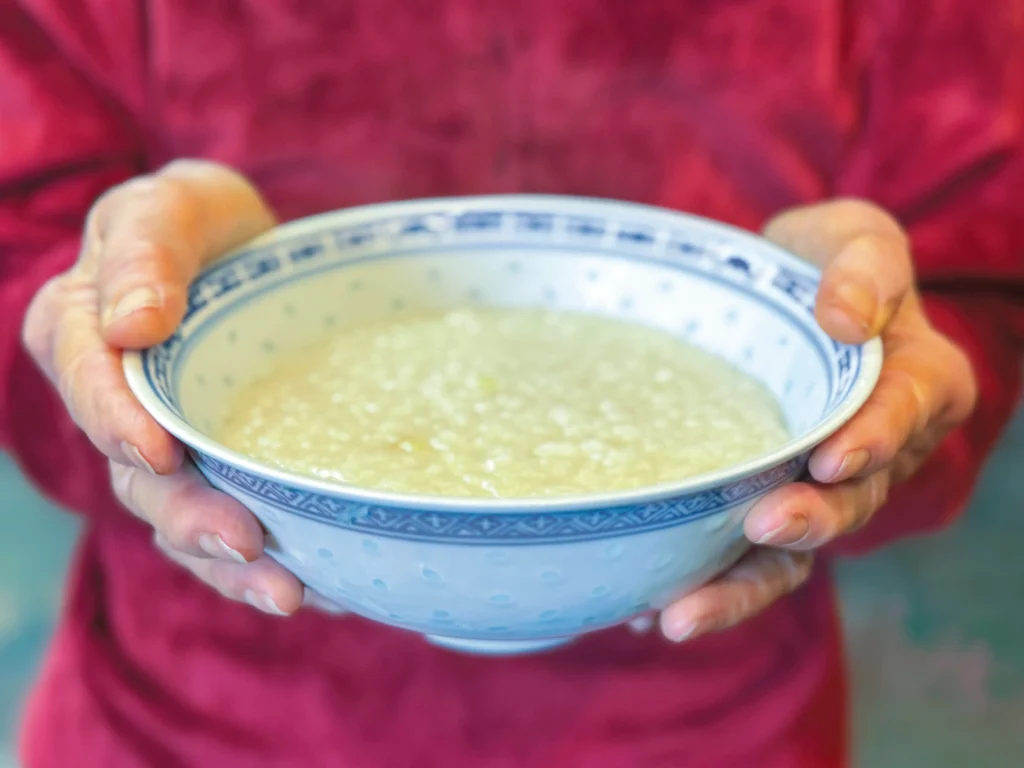
Thick or thin, the consistency is up to you. When I crave congee, I look for creamy and soothing. Four variables matter: rice variety (short- and medium-grain make creamier congee than long-grain); water ratio (more water makes it thinner, less makes it thicker); cooking time and heat. Adjust the texture with hot water at any stage.
Always rinse the rice to remove excess surface starch, and always use a pot at least double the volume of the liquid—whether cooking with a rice cooker or on the stovetop—so it doesn’t foam up and boil over.
Three Cooking Methods
The following cooking methods are for making 5 cups of congee with 1/2 cup of uncooked rice. Scale rice, water, heat and time proportionally for larger batches.
Stovetop—Traditional
Rinse 1/2 cup rice in a fine-mesh strainer with two or three changes of water; drain well. In a large, heavy-bottomed pot, bring 5 cups of water to a boil. Add 1 tablespoon neutral oil, 1/2 teaspoon kosher salt and 2 slices fresh ginger. Sprinkle in the rice. When the water returns to a boil, lay two wooden chopsticks across the pot rim, set the lid ajar, reduce heat to medium-low and simmer at least 2 hours. Stir periodically, adding hot water to reach your preferred consistency.
Pros: nuanced aroma, classic texture.
Cons: requires time and vigilance.
Stovetop 20-Minute Hack Using Frozen Rice
Rinse 1/2 cup rice; drain and transfer the wet grains to a pint glass mason jar or a quart-size zip-top bag. Freeze for at least 8 hours (or up to 3 weeks). The clinging water expands, breaking down the grains so starch releases fast. To cook, add 5 cups room-temperature water, 2 slices ginger, 1 tablespoon neutral oil and 1/2 teaspoon kosher salt to a large pot. Add the frozen rice (no need to thaw). Bring to a boil, prop the lid ajar with chopsticks, reduce to medium-low and simmer, stirring once or twice and adjusting consistency with hot water. Creamy congee forms in about 20 minutes. What a time savings!
Pros: speed.
Cons: requires planning ahead.
Rice Cooker—Porridge Setting
A household that consumes a lot of rice invariably has a dedicated rice cooker—a fancy, computerized, multifunctional one at that. Add your ingredients and press the button that says “Porridge.” For 5 cups congee, you must use a cooker sized for 5 cups uncooked rice or larger. Rinse 1/2 cup rice and place in the inner pot with 5 cups water, 1 tablespoon neutral oil, 1/2 teaspoon kosher salt and 2 slices ginger. Close, press Porridge. Many models run 60–70 minutes through soak, boil, simmer, warm, via fuzzy logic. Open the lid anytime to stir or adjust with hot water. When the texture pleases you, stop and finish with seasonings.
Pros: mostly hands off; consistent.
Cons: requires a specialty rice cooker.
Seasoning & Toppings
For mild, soothing congee, practice restraint and aim for balance. Rice cooked with water, a little oil and salt showcases its innate grassy sweetness. Clear broth is a fine upgrade; chicken or pork bones add calcium and collagen. You might like to enhance the flavor with small amounts of raw vegetables or meat, taking care not to overload the subtle base.
Add your aromatics: fresh ginger, scallions, cilantro, white pepper. Don’t skimp on salt and ginger; they calm frayed nerves and acid stomachs.
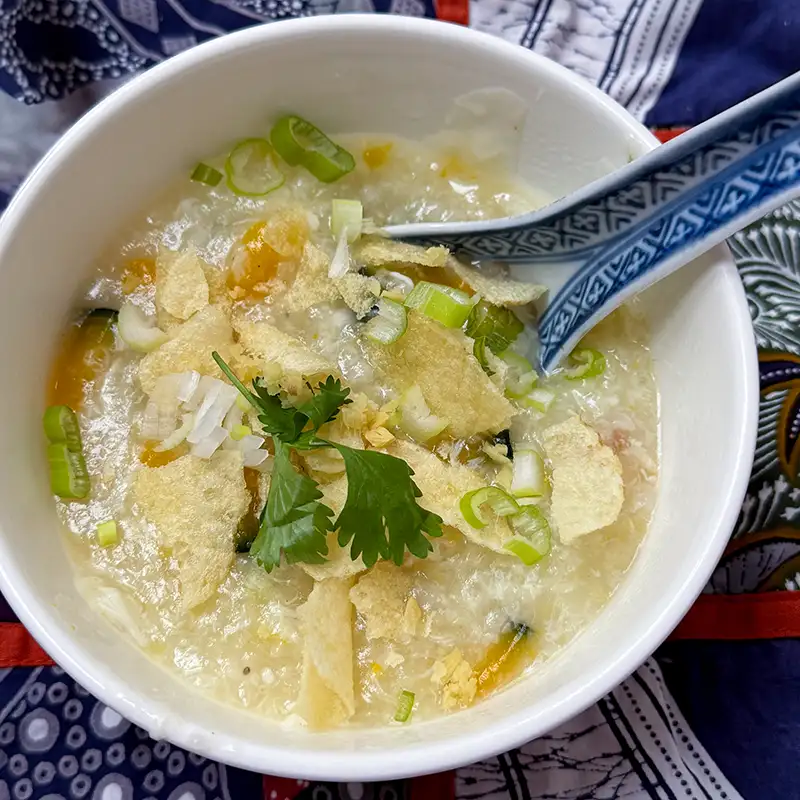
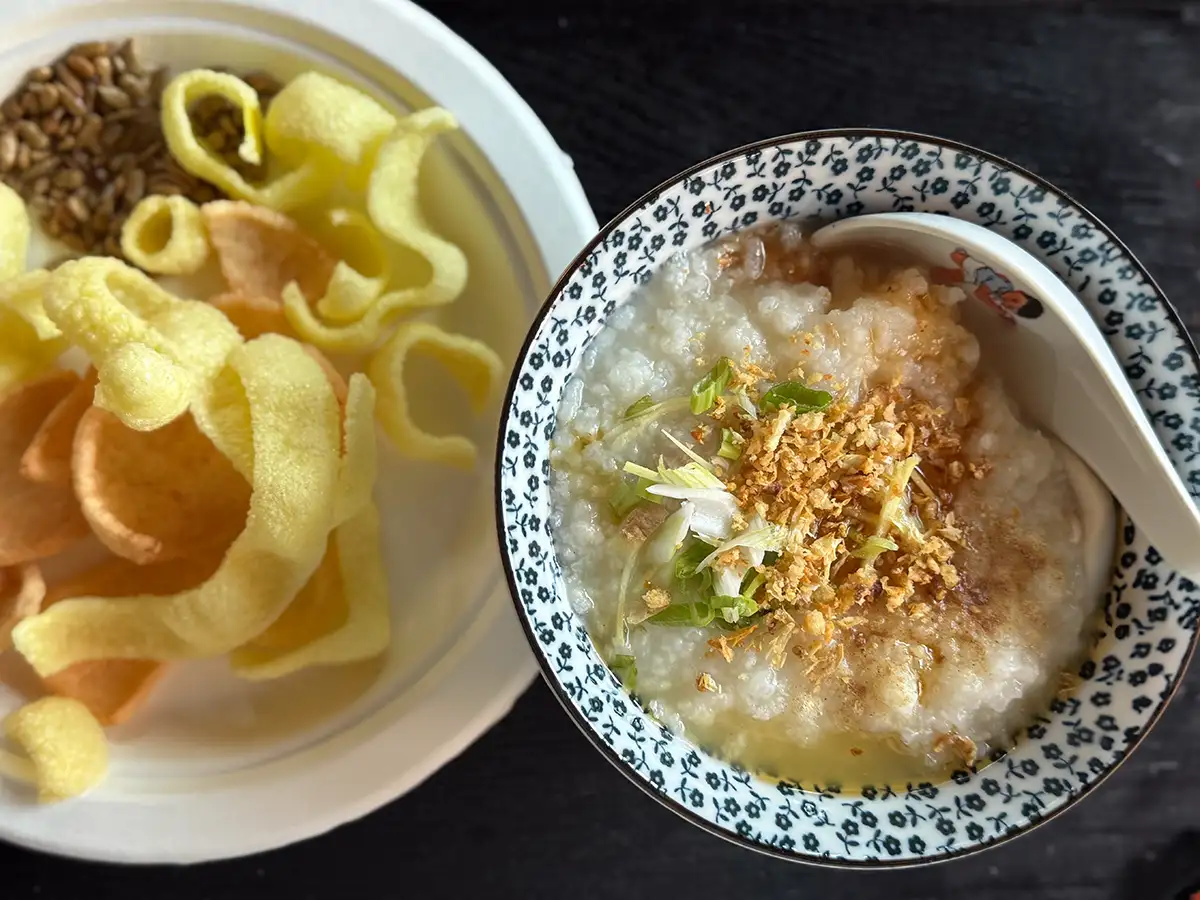
When you want to dazzle and impress, it’s all about the toppings: soy sauce, fish sauce, chili sauce, miso, chili crisp, Indian chutney. Add some crunch: salted nuts, shrimp chips, fried bread, even crushed potato chips make a great topping.
At its core, congee is a subtle, honest dish. It can also be bold, textured and deeply flavorful. You can keep it simple or dress it up. It is my ritual for comfort food and can be yours, too.
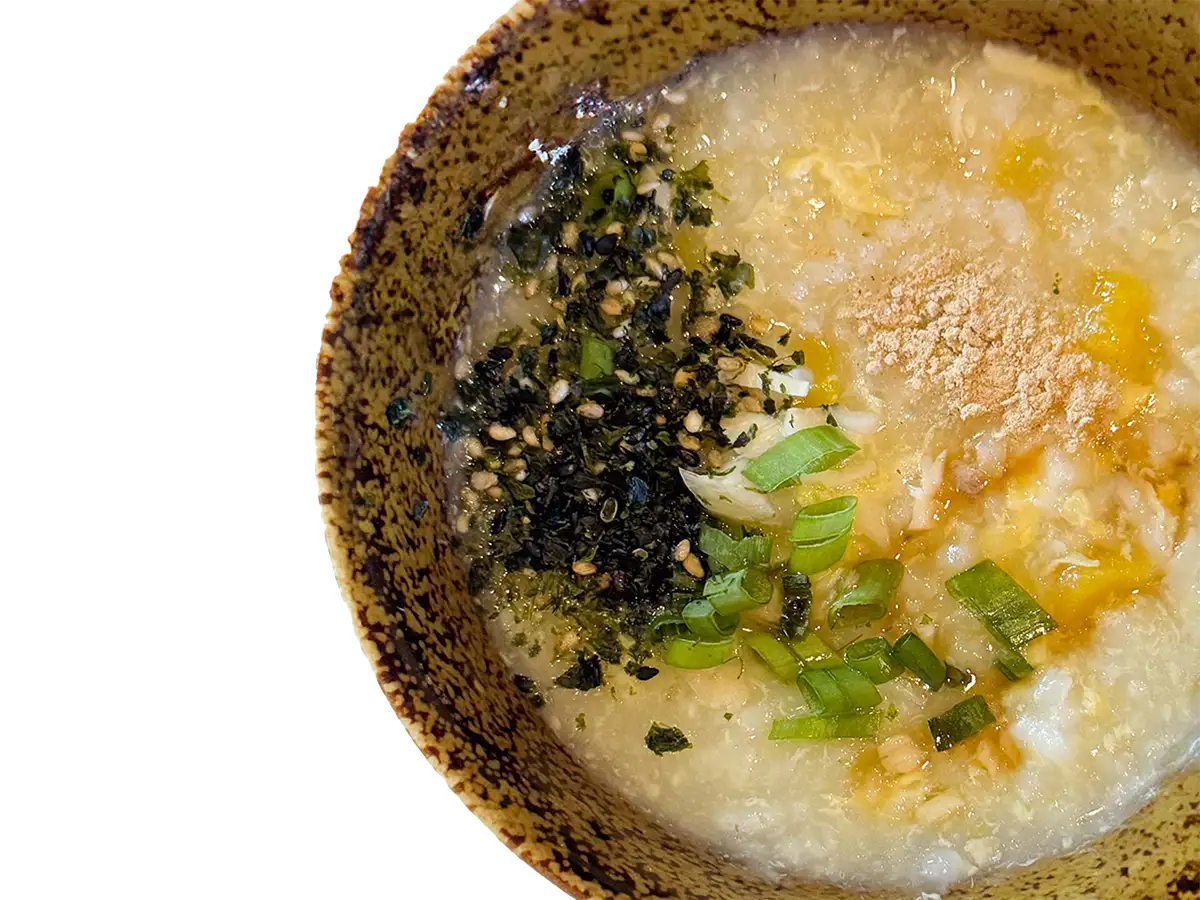
Here is a recipe that’s become a household favorite. It’s fast and simple. But I love congee in its many forms, including Cantonese congee using dried scallops and fresh fish or keeping it plain and simple, letting the toppings be the main act. As I began compiling my recipes, I dedicated time to make a delicate Okayu-style Japanese congee for my dear friend and neighbor Chiyo Suzuki. Her special congee was vegetarian, simple and soothing, using eggs and kabocha squash. She passed in September. She was a good soul—a perfect neighbor—always responding with kind gestures for friendly conversations or gifts. When she reached a point she couldn’t reciprocate that’s when I knew: send her more congee. Find these recipes and more at EdibleSantaBarbara.com.