Bánh mì in Santa Barbara
On a recent Saturday the Chung King restaurant on Hollister Avenue in Goleta rang with international babble as diners speaking Vietnamese, Thai, Cantonese, Mandarin and English enjoyed the Vietnamese dishes featured on the weekend menu.
Owners Phuoc-chan Tu and his wife are pleased with the reception their expanded menu is receiving. “Customers are mostly Vietnamese, some Thai, some Americans, many students,” Mr. Tu states. “They all clean up their plates!”
The Chung King is very much a family affair. Mr. Tu and his brother take care of the Chinese side of the menu, and Tu’s sons and daughter wait tables. Mrs. Tu is in charge of preparing the Vietnamese dishes, which she calls ” labor intensive.”
“We decided to try Vietnamese food about four months ago,” she says, “because we noticed that nobody here was doing it. We wanted to introduce it to the community.”
These were the words written by Carrie Brown and Fran Davis in 1993 about a Chinese restaurant in Old Town Goleta rolling out a small Vietnamese menu on weekends only. At the time, the town’s daily newspaper was the Santa Barbara News-Press, but their freelance efforts didn’t go to print here. Credit goes to Chile Pepper magazine, based in Santa Fe, New Mexico, for first publishing it.
It’s 33 years later and I’m staring at the words for the first time, printed on faded paper, retrieved from a manila folder of one of the writers, Carrie Brown, who also happens to be my mother. I’m trying to track down information based on an equally faded memory about the first time I had bánh mì.
It was the summer of 1993 and I was home in Santa Barbara for school break. My parents were excited to share that they’d found Vietnamese food here, at a Chinese restaurant in Goleta, served only on weekends. Like a secret menu, but one they didn’t want kept a secret. They wanted to go every weekend; it was that rare and special. It was also very, very good, according to these accredited anthropologists who had done their field research in Southeast Asia. The only compromise Chung King had made to the food was serving it only on weekends.
On a Saturday afternoon back then, I stared at the menu and none of it made sense. Bún Bò Huế and Cơm Tấm Thịt Nướng were unfamiliar at the time. My father pointed me toward the bánh mì, saying it’s a sandwich, and it’s delicious. It was also priced under $2, maybe $1.50 or $1.75. At that price, if I didn’t like it, I wouldn’t have wasted much of their money. I ordered it.
There are times when you feel like your life has been operating in black and white, and suddenly it roars into vivid color. That was the effect of biting into my first bánh mì. The crisp bread! The grilled pork! The cilantro and mint, and the pickles! It became and still remains one of my top five favorite sandwiches. Did I mention it cost just a dollar and change? The sandwiches at Sam’s To Go were already around $5 at the time! Everything about it was perfect. My family feasted at Chung King many times that summer, and I consumed bánh mì like any college youngster trying to survive on the rowing team would: by eating as many as I could.
By the time I returned again to Santa Barbara, Chung King was gone. But my love for bánh mì never waned. Any trip farther into Southern California or up to the Bay Area was an opportunity to stop into a Lee’s Sandwiches en route to get a #5 (grilled pork) to go. Rob, my now husband, had his own favorite: #14 (pork roll and pâté) so that was added to the regular order as our relationship grew.
In the Santa Barbara of today, there are limited options for bánh mì. There are numerous sandwich shops that offer a bánh mì, but usually only a single version of the sandwich. Pho shops can have a few bánh mì on the menu (like SB Pho in Victoria Court). Head a little farther south to Ventura and there will be more options. Even further, in Orange County’s Little Saigon, is an epicenter of shops and community. But here, now, we make our own, adapted for our locality and access to ingredients.
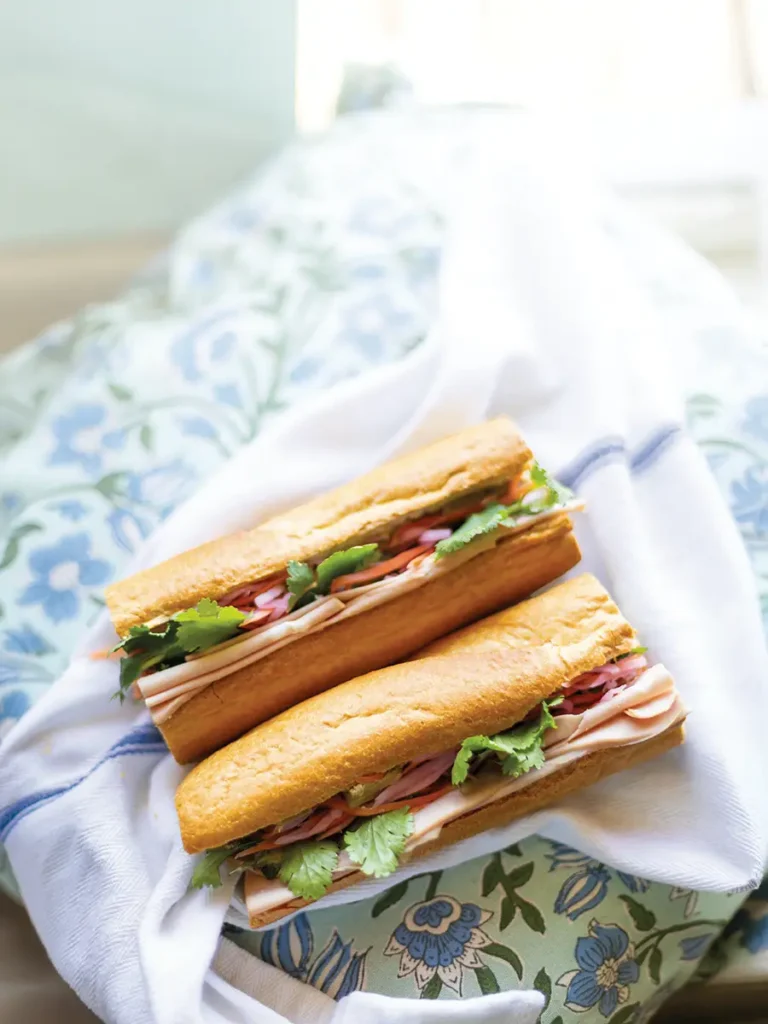
Bánh mì’s main filling varies. Be it grilled pork, grilled chicken, lemongrass beef, headcheese, pâté… the list goes on, I’m not here to say there’s only one kind to be truly authentic. What makes the bánh mì—to me—is everything else. The support crew is what carries the show.
- A lightly crisped roll, like a baguette, or a bolillo gets close. I’ve toasted a hot dog bun before.
- A little chicken liver pâté, which is optional for some but does contribute to the overall flavor of bánh mì.
- Kewpie mayonnaise (standard mayonnaise is an acceptable substitute).
- Vietnamese quick pickles or Đồ Chua (see recipe on page 22). You really can’t skip this one.
- Fresh sprigs of cilantro
- A few leaves of fresh mint
- A few slices of fresh jalapeño, depending on your heat preference
- A few slices of cucumber, or not!
- Maggi sauce
- And finally, my main act, which isn’t the main act at all: slices of mortadella. You can find mortadella at the Cheese Shop or Bristol Farms in Santa Barbara. But try ham, meat from the summer grill, tofu or vegetables if that’s your preference. The key is the everything else waves hands to the words above.
To assemble, slice the roll open and spread both sides with Kewpie mayonnaise. Then start layering on the bottom half: a slather of pâté, draped mortadella, pile on the fresh mint, cilantro, jalapeño, then the pickles. Add a dash of Maggi sauce and press on the top of the bread. It can be a messy affair, which is proof that I’ve taken liberties and made adaptations as bánh mì is typically a café snack and doesn’t come with a bib. If you’ve hit the right balance, you’ll get the soft, crunchy textures, the sweet, sour and umami flavors in every bite and hopefully the bread will soak up the juices and sauces.
The year 1993 doesn’t seem that long ago, but it is. Places like Saigon Noodle House or Noodle City in Goleta feel like they’d been around forever, but apparently are more recent than I realize. It’s hard to believe that as recently as 1993 Vietnamese food in a restaurant only existed as a short-lived weekend menu within another restaurant in Santa Barbara, but these fading papers I’m reading of my mother’s corroborate it. As fate may have it, my memory might eventually fail me, as it did my father’s. It already feels that way.
Chung King in Goleta is long gone, but the building at 5877 Hollister Avenue remains and is now the Old Town Cafe, a lovely spot in its own right. Also long gone is the price point of their bánh mì. We will never see the cheap eats of a $2 sandwich like that again; that’s just reality. But the memory of the taste still makes me salivate, and I get that tingle in my jaw. I’ve been conditioned, Pavlovian style, to respond. At the current price of gasoline—and, honestly, everything—there are no dedicated trips north or south to buy bánh mì. But I have the basic recipe, shops around town to collect the ingredients, the farmers market to buy my daikon and carrots (colorful varieties or not) and all the fresh produce. When the urge hits, I can make my own and let both the flavor and nostalgia satisfy my taste buds and hit me in the feels. Perfection.
Rosminah Brown
Rosminah Brown is a Santa Barbara native who types fast and eats slow. She once jumped in the Neptune Pool at Hearst’s Castle. She is still upset that JR’s BBQ closed. She is always seeking a perfect, singular, exquisite bite of food.